Dune finds equity tokens drive tokenized-asset trading while Treasury funds sit still
The analytics platform puts tokenized real-world assets at $34.5 billion and says the value of individual-stock token holdings grew ninefold in a year.
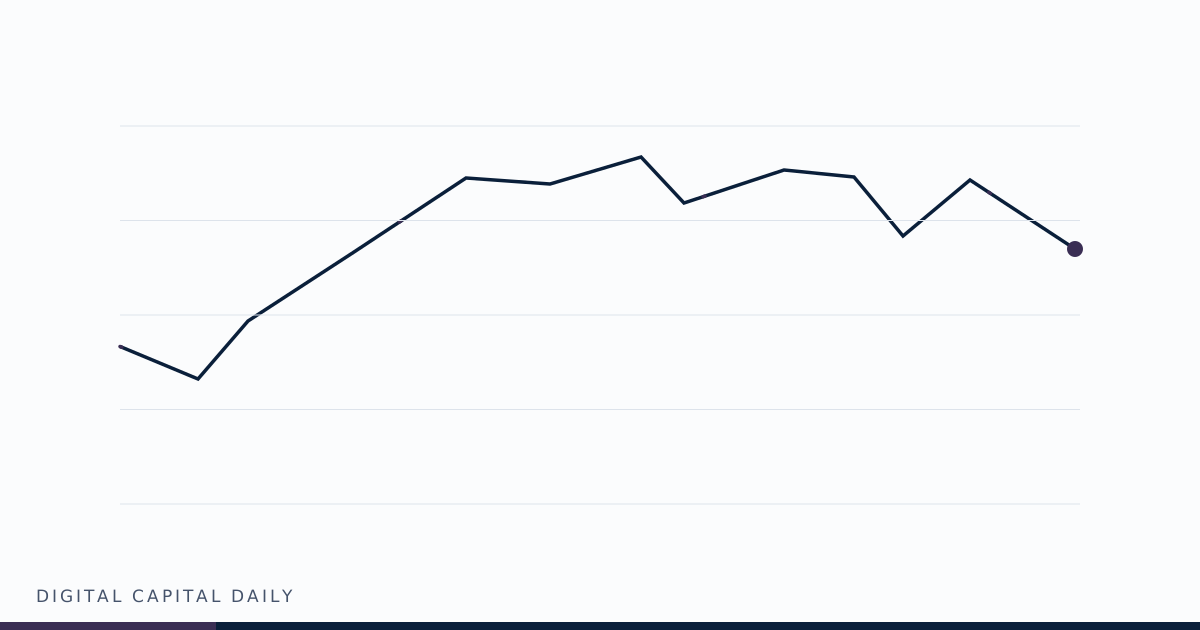
Eight percent of the supply produced 93% of the spot volume in August; tokenized Treasury funds turned over 0.006% of theirs. Both figures come from Dune's segmentation of the tokenized-asset market, and together they split the category more sharply than most of the language used to sell it: a small, fast-turning equity market on one side, a book of positions that barely changes hands on the other.
Dune puts tokenized real-world assets at $34.5 billion, with equity tokens making up 8% of that supply and generating 93% of spot volume while Treasury funds turned over 0.006%. Turnover at that level is not a market; it is a balance — a book whose holders are parked rather than trading, which is roughly what the collateral side of this business would look like arriving without anyone noticing. The Dune figures do not identify the holders, and the turnover is not broken down by venue or counterparty.
The composition points the same way: 81% of tokenized equities held in spot markets are individual stocks, and the value of individual-stock token holdings grew ninefold over the past year. That 81% covers tokenized equities held in spot markets, a narrower population than the category as a whole, and the coverage does not say how much sits outside those venues. The institutional case for tokenization has been argued mostly in terms of fund records, collateral and settlement; the activity the report can measure is single-name equity trading.
Put the two cuts together and the picture narrows further. Equities are 8% of tokenized real-world asset supply and 93% of its spot volume, so the remainder is where the balances sit and equities are where anything moves; inside equities, 81% of what is held in spot markets is single-name exposure. The part of the market that trades is a subset of a subset.
What concentration at that level means is harder to establish than the split itself. A market where 8% of supply carries 93% of the tape is one with narrow participation — thin books outside whatever names carry the flow, though not necessarily few traders. The coverage does not say which stocks those are, how many venues list them, or whether the volume is spread across a long tail or packed into a handful of tickers. Until that is known, the 93% is a statement about liquidity rather than about demand.
Two caveats belong on the growth figure. The coverage does not give the dollar base the ninefold increase is measured from, and ninefold from a small base describes a different market than ninefold from a large one. The number also sits awkwardly beside Dune's own forward estimate: the report puts total tokenized real-world asset supply above $34 billion in 2026, barely above the $34.5 billion it already counts. Read at face value, that is a supply forecast for consolidation rather than takeoff, even as the stock-token share compounds.
Supply and activity are the two gauges the industry uses on itself, and they point in opposite directions here. Supply measures what has been issued; volume measures what anyone will own at a price. A category can grow the first while the second stalls, and a $34.5 billion market with a 0.006% turnover floor and a ninefold jump in one narrow segment is what that looks like. The question for the next twelve months is not whether tokenized real-world assets grow, but which of the two numbers moves.
The Treasury side is the more revealing half precisely because so little happens there. Turnover of 0.006% of supply in a month is what inventory looks like when it is held for a purpose other than price discovery, and that is the only reading the Dune data supports. If those balances rarely move, the funds function more like stored collateral than like cash management, and supply can accumulate in a product like that for a long time without any of it changing hands.
A rule written for the venue
The week's regulatory news went to the place where shares change hands: the SEC allowed certain venues to trade tokenized U.S.-listed stocks onchain, two days after the Senate declined to advance the comprehensive framework that would have sorted digital assets between securities and commodities, and the same stretch included CFTC relief. The coverage does not name the venues.
The shape of that relief matters as much as its timing. It covers tokenized versions of U.S.-listed stocks — securities that already trade on registered exchanges — which makes the onchain market a second venue for existing shares rather than a new way to issue them. Nothing in that design creates primary-market activity. Dune's numbers describe what the secondary activity looks like: concentrated in single names, compounding in value, and starting from a base the report does not disclose.
What the relief addresses is where shares change hands, a narrower target than the tokenization pitch usually implies. The coverage does not describe provisions aimed at issuance, at custody, or at the records that sit behind a share — the part an allocator would test before a tokenized equity could sit inside a mandate. Whether the SEC's ordering reflects deliberate sequencing or simply what was available two days after the Senate vote, the report does not say.
The rest of the week's rulemaking ran along the same seam, toward permissions rather than products. The FCA opened its crypto authorization window, giving firms roughly five months to apply ahead of a Feb. 28, 2027 continuity deadline, with the regime itself starting Oct. 25, 2027, according to The Defiant. Regulators spent the week deciding who may operate. What gets built on top of those permissions is a separate question, and the Dune figures are one answer to it.
Institutional intent, meanwhile, keeps surfacing in surveys rather than in order flow. An Uphold survey found 75% of U.S. banks have blockchain programs and 22% are live, with more than half of respondents reporting over $50 billion in assets and 54% having issued RFPs to digital asset vendors. Those are procurement numbers. Nothing in them describes the flow that produced 93% of August's spot volume in equity tokens, and both readings can be accurate because they cover different parts of the same build-out.
For the advisory and family-office end of the market, the practical question is narrower: whether a tokenized U.S.-listed share becomes a security a wealth manager can custody in a client account. That turns on corporate actions, on settlement an administrator will book, and on whether the wrapper fits inside a mandate. None of those generate volume, and the week's approvals do not address them. A trading venue can be built without answering any of those questions, which is what August's numbers suggest happened.
A copy of the record, in Brazil
Brazil's depository CSD BR shows what the other kind of tokenization looks like when it is built. It mirrors BTG Pactual fund records on the XRP Ledger, keeping its own database as the legal record and publishing a blockchain copy that approved banks and companies can reconcile in near real time. The chain carries a copy while the depository keeps the record that governs, and the purpose of the exercise is reconciliation rather than trading.
Set beside the Dune figures, that project would never appear as spot volume. It is the institutional case made concrete — ownership records participating institutions can check against their own books — and it produces almost no turnover by design. If a tokenized equity is ever going to matter to an allocator rather than a day trader, the work will look more like the depository's than like August's order flow, and it will be judged by whether the records reconcile rather than by how much changes hands.
The gauge for the next few months is which number moves. Individual-stock token holdings grew ninefold in value over the past year, and continued growth of that order would make the trading venue the center of gravity for onchain equities while pushing any institutional version of the product toward a different set of rails. Treasury-fund turnover is the other gauge. Until it lifts off 0.006%, the Treasury side of a $34.5 billion market stays what it has been: an asset that is held, valued, and not much else.
Save this analysis and keep the funds you follow together in My Desk.
Sign in to save articles or follow funds. The Wrap
HSBC hedges HANetf bitcoin ETCs while readying Hong Kong dollar stablecoin
 The Wrap
Blockchain.com seeks $500 million IPO at $4 billion to $6 billion valuation
 The Wrap